

I started building websites the way most people my age did in the late ’90s — badly, with great enthusiasm, and armed with nothing but View Source. Find a page you like, right-click, reverse-engineer it line by line: nested tables for layout, <font> tags doing the work CSS hadn’t earned yet, an animated “under construction” gif that never seemed to come down, and a hit counter quietly tallying up every visitor who ignored it. Clumsy, but it taught me a website wasn’t magic — it was just text, and text could be learned.
I later put some formal structure behind that instinct, studying graphic design and UX at NBCC. It gave language to things I’d been doing by feel — hierarchy, whitespace, the idea that a layout should guide someone rather than just display information at them.
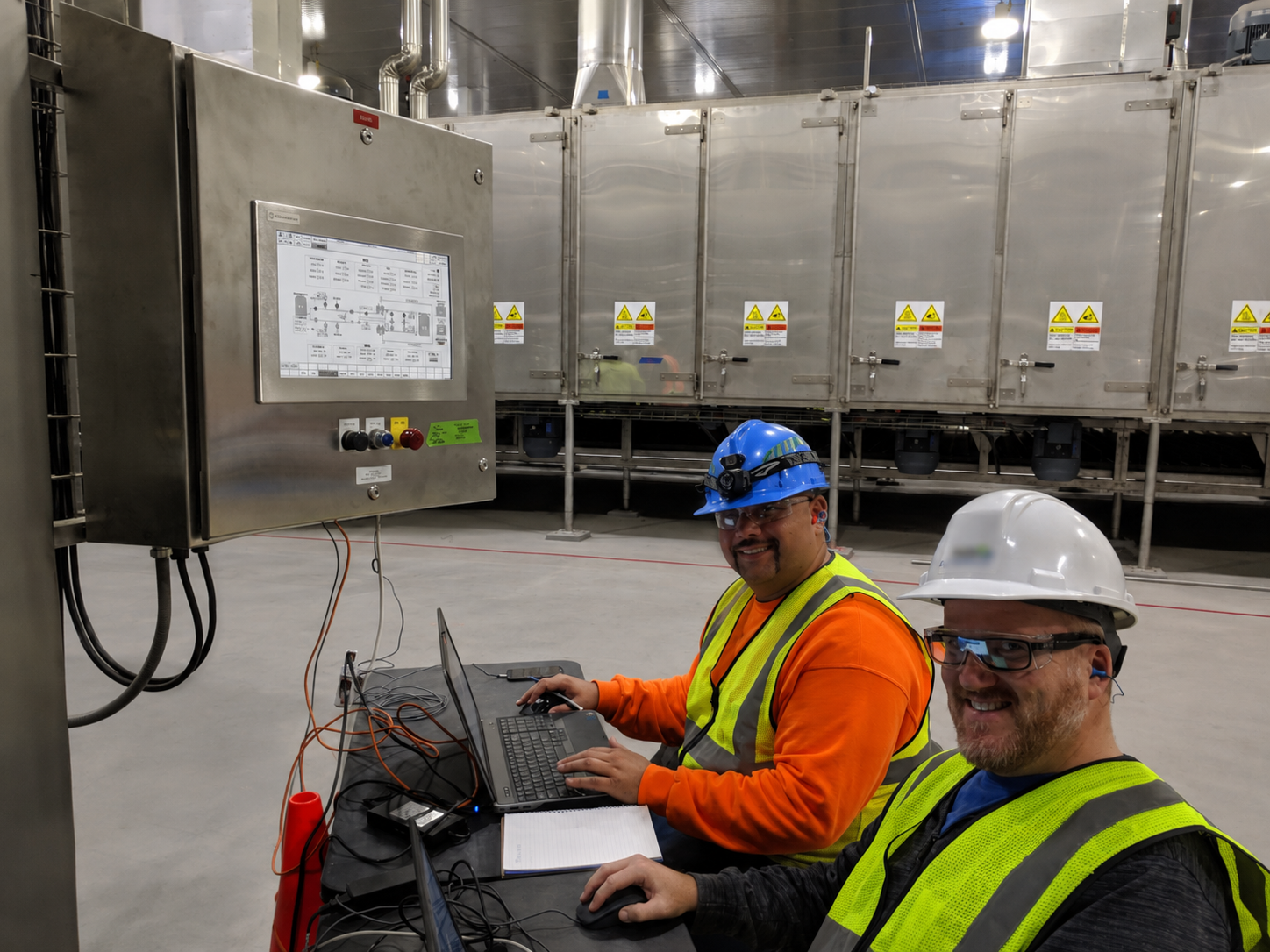
Then my career took a hard left into industrial control systems — PLC programming and, eventually, building the SCADA displays operators watch all day to know what a plant is doing. That work turned out to be UX design in its highest-stakes form. High-performance HMI design is about stripping out everything that isn’t information, so the one thing that matters is the one thing that stands out. An operator doesn’t have time to parse a cluttered dashboard. Neither does anyone visiting a website — I just learned that lesson where the stakes were a production line instead of a bounce rate.
Meanwhile, the actual web design kept happening in fits and starts, mostly as favors. Dreamweaver made it easy to spin up a quick site without really understanding what I was building. WordPress never hooked me — I could make it work when I had to, but it always felt like babysitting somebody else’s software rather than building anything of my own. Squarespace was better for quick favors: fast, clean, low-maintenance, right up until someone needed something the template didn’t support, and I was negotiating with the platform instead of just building the thing.
And I kept seeing the same pattern when I looked at actual business websites: strong products and good stories, but the sites themselves often felt slow, generic, or impossible to evolve once the owner needed something the platform didn’t allow.
That’s the itch that brought me back to code — properly this time. Astro is static-first, so sites are fast in a way template builders rarely are. It’s component-based, so I’m not rebuilding the same header five times. Under the hood it fits neatly into the Jamstack world — pre-rendered pages that can still do everything a client actually needs, without dragging in a heavy framework. And it puts me back in direct contact with the markup, the way View Source did twenty-five years ago — except now I actually know what I’m looking at.
I didn’t plan this arc, but I can’t ignore the symmetry: raw HTML, to WYSIWYG shortcuts, to a CMS that never clicked, to templates with a ceiling, and back to code — carrying everything I learned along the way, including the parts that had nothing to do with the web. And I know what it means to design for clarity under pressure, because I spent years building screens where clutter wasn’t just bad design — it was a safety issue.
That’s why I’m building this studio now, on this stack: the design sensibility from NBCC, the discipline of PLC logic, and the ruthless clarity of a high-performance SCADA display, all finally pointed at the same problem.
I spent a long time getting back to where I started. That’s what I bring to every project now with Fundy Forge.